
About The Vocation Tree

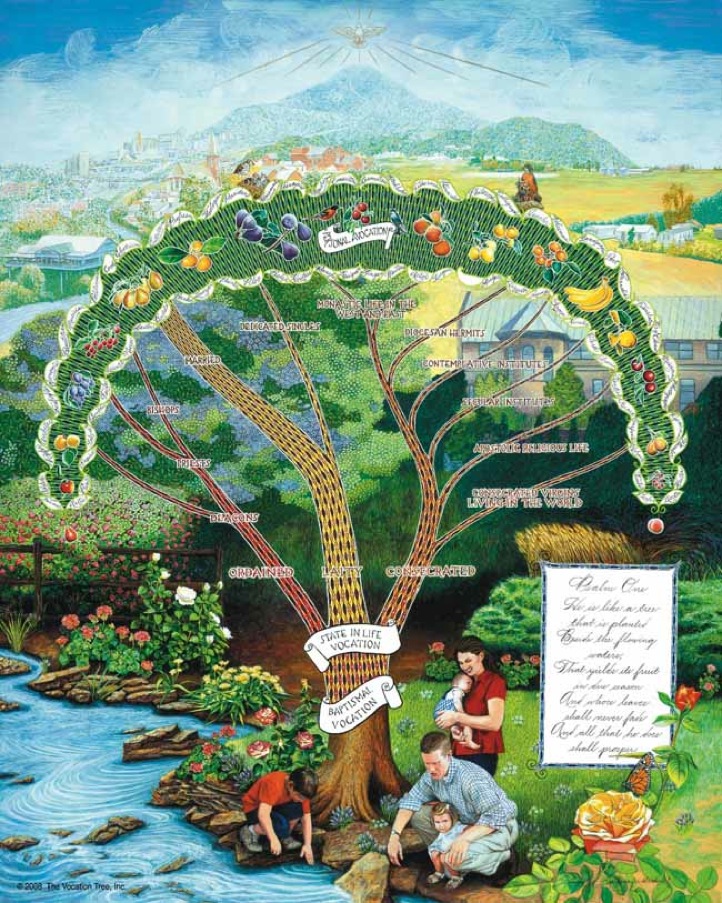
The Vocation Tree artwork depicts the myriad of unique ways of life which, in accord with the plan of the Lord Jesus, make up the life of the Church. Rooted and grounded in the baptismal call to holiness, the Christian discerns a particular state of life vocation with its inherent mission: the lay - activity in the world; the clergy - ministry; consecrated men and women - special conformity to Christ, chaste, poor and obedient. Displayed by the array of branches on the tree, the Holy Spirit "establishes the Church as an organic communion in the diversity of vocations, charisms and ministries." (VC 31 ¶ 2)
"These state of life vocations are at the service of one another, for the growth of the Body of Christ in history and for its mission in the world." (VC 31 ¶ 3) The fruits of the Spirit are evident in the myriad of occupations and activities (i.e., personal avocations) pursued by the baptized and depicted by the fruit and leaves of the tree.
Each individual Christian is uniquely called by God, beginning at Baptism, to go into the world and to bear much fruit. The Vocation Tree helps to illustrate that this unique, individual vocation given to each Christian embodies many components, "not just the calling to make a single commitment - to marriage, consecrated life, or ordained ministry. As its elements are discerned and accepted, a personal vocation leads to a closely-knit pattern of integrated commitments that organize the whole of life in the light of faith through implementing choices." (Germain Grisez and Russell Shaw, Personal Vocation - God Calls Everyone by Name, pg 97)
The branches of the tree, ordained, lay, and consecrated, provide a network of supportive relationships ordered to build up the Body of Christ in love. "As all the members of the human body, though they are many, form one body, so also are the faithful in Christ (cf. 1 Cor.12:12). Also, in the building up of Christ's body there is engaged a diversity of members and functions. There is only one Spirit who, according to his own richness and the needs of the ministries, gives his different gifts for the welfare of the Church (cf. 1 Cor. 12:1-11)." (LG 7 ¶ 3)
Look closely and you'll find yourself in this tree, the Church, which is rooted and grounded in Christ. Your faith life grows from the base of baptism, is given definition through commitment in one of the branches of lay, ordained, or consecrated vocations, and bears the distinct fruit and leaves of your particular gifts and talents in the occupations and activities you choose. And yet, the Vocation Tree illustration is not a comprehensive picture of the entire Church! Particularly within the laity, many other branches exist and bear fruit, including children, adolescents and young adults who have not yet discerned a state in life vocation, widows and widowers, those who are separated, and single persons open to marriage. The Vocation Tree is meant to illustrate vocations in life that are both discerned and chosen.
Those vocations which are entered into through a prayer of consecration (ordained and consecrated virgins living in the world), as well as those involving a vow (marriage and most forms of consecrated life) involve lifelong commitments. The "dedicated single" vocation does not necessarily involve a lifelong commitment, although it may be freely discerned and chosen for a lifetime.
The Vocation Tree uses the term "personal avocation" instead of "personal vocation" in order to illuminate the distinction between the active dimension of living out one's unique call from God from the mission dimension embraced by responding to one's state in life vocation. Most Catholics hear the word "vocation" and think of the call to be a priest or a nun, and in a secular context the word "vocation" commonly refers to training in a skilled trade, like woodworking or plumbing. In the Christian understanding, both dimensions flow from the baptismal call to holiness:
- "State in Life" vocations involve lifelong choices made in response to God's call, having most to do with how a person will live his or her life - relationships, mission, commitments.
- "Personal Avocations" include the activities through which God calls a person to bear fruit, always discerned and chosen in the context of one's state in life vocation.
Yes, the tree of the Church is very rich! For example, permanent deacons may also be married; and there are some circumstances of diocesan priests who are married; and some religious institutes of consecrated men include men ordained to the priesthood.
The term consecrate means to set aside for a sacred use. The Vocation Tree reflects three distinctions of the term "consecrated" in reference to vocational calls:
- A Christian is consecrated at his or her baptism - set aside for God alone.
- The Church also refers to the state of consecrated life as a particular call stemming from the baptismal consecration, a call which involves the setting aside of a particular person as one who is to live as Christ himself, chaste, poor, and obedient.
- Within the state of consecrated life, there is the particular vocation of Consecrated Virginity Lived in the World. In this particular vocation, the consecration sets the virgin aside as a sacred person in the Church, one who is given the title bride of Christ, a title she shares with the Church herself.
Members of third orders (sometimes called by other names) embrace the spirituality of a particular religious tradition, such as Carmelite, Franciscan, Benedictine, Ignatian, or Dominican.
Traditionally, "first order" refers to the masculine branch of a religious family; "second order" refers to the feminine monastic branch of a religious family; and "third order regular" refers to those in active religious communities. "Third orders secular," known commonly today simply as "third orders," are associations of laity, and sometimes diocesan priests, who embrace the spirituality of a particular religious tradition while remaining in the state of life in which they have been living. It might be pointed out that the Vocation Tree artist has signed her name, "Mrs. Jennifer Ward, O.P." indicating that she is a married woman following the Dominican spirituality in her married life.
The Vocation Tree distinguishes three states of life (ordained, lay, and consecrated) while earlier Church understanding has often distinguished only two states (ordained and lay.) The addition of consecrated life as a distinct, third, state in life stems from the teachings of the Second Vatican Council: "The state of life which is constituted by the profession of the evangelical counsels, while not entering into the hierarchical structure of the Church, belongs undeniably to her life and holiness." (LG 44. 4) The distinct state of consecrated life is further affirmed and clarified in the Catechism of the Catholic Church and in the apostolic exhortation Vita Consecrata.
A reference to "lay consecrated" seems to be premised upon the earlier understanding of only two states in life, with recognition of the consecrated state as a category of the lay state. Another question may arise as to which particular form of consecrated life is lived by the "consecrated" members of particular movements. The groups may not fit precisely into the understanding of the traditional forms of consecrated life shown on the Vocation Tree. The Church in time defines the nature of membership in new movements.
The Vocation Tree concept - outlining the various ways in which Christians live out their baptismal vocation - developed as consecrated virgins began to explain the distinct vocation of consecrated virginity lived in the world. Profit from the sale of Vocation Tree products will be used for the purpose of promoting a fuller understanding of vocations in the Catholic Church.
"The artist has a special relationship to beauty. In a very true sense it can be said that beauty is the vocation bestowed on him by the Creator in the gift of 'artistic talent'. And, certainly, this too is a talent which ought to be made to bear fruit, in keeping with the sense of the Gospel parable of the talents (cf. Mt 25:14-30)." (John Paul II to Artists, 1999)
Artist Jennifer Ward lives in Cincinnati, Ohio, with her husband and four children. She maintains an art studio in her home and focuses on preparing artistic representations of Catholic mysteries. In the Vocation Tree illustration, the child reaching into the water is the youngest child of the artist and her husband, and the family to the right of the tree are friends of the artist.
Professor, Theologian, Philosopher, Journalist, Teacher, Babysitter, Librarian:
The Second Vatican Council speaks of teaching as a vocation: "...of highest importance is the vocation of those who help parents in carrying out their duties and act in the name of the community by undertaking a teaching career. This vocation requires special qualities of mind and heart, most careful preparation and a constant readiness to accept new ideas and to adapt the old."(GE 1965, 5.2)
Doctor, Dentist, Surgeon, Nurse, Therapist:
From the Charter for Health Care Workers (1995) published by the Pontifical Council for Pastoral Assistance to Health Care Workers: "The Catholic physician's profession requires them to be a custodian and server of human life.... This is their mission, and is the fruit of a call or vocation that the physician hears, personified in the suffering and invoking face of the patient who trusts in their care. Here the physician's mission to give life is linked to the life of Christ, who came to give life and to give it in abundance. (Jn. 10:10) Through their therapeutic ministry, physicians thus share in the pastoral and evangelizing action of the Church. (Pontifical Council for Pastoral Assistance to Health Care Workers 1995)
Farmer, Landscaper, Hunter, Rancher:
Field workers and farmers are also addressed. In a letter from Pope Paul VI to the president of the International Catholic Rural Association, he notes that "respect for nature brings the rural worker close to God, for it reflects his respect for and his worship of the Creator. Such an intimacy with God and the collaboration with his plan for the growth of the fruits of the earth can be a leaven in your spiritual lives. It can be especially attractive to young people, who find such appeal in simplicity of life." (1975)
Economist, Consultant, Stockbroker, Clerk, Banker:
Author Michael Novak, in his book Business as a Calling: Work and the Examined Life By Michael Novak (The Free Press, 1996) references John Paul II in describing business people as those who embrace their vocation as laity, utilizing virtues of diligence, industriousness, prudence in undertaking reasonable risks, reliability and fidelity in interpersonal relationships, as well as courage in carrying out decisions which are difficult and painful but necessary, both for the overall working of a business and in meeting possible setbacks. Mr. Novak also points out three cardinal virtues the business world fosters in the human person: creativity, building community and practical realism.
Printer, Engineer, Laborer, builder, butcher, carpenter, dry cleaner, landscaper, homemaker, electrician, architect:
From Laborem Excersens (1981), John Paul II's encyclical on human work: "Man is made to be in the visible universe an image and likeness of God Himself, and he is placed in it in order to subdue the earth.... Only man is capable of work, and only man works, at the same time by work occupying his existence on earth. Thus work bears a particular mark of man and of humanity, the mark of a person operating within a community of persons.... The Church considers it her task always to call attention to the dignity and rights of those who work."
Artist, Sculptor, Writer, Photographer, Poet, Musician, Calligrapher, Painter:
From John Paul II's Letter to Artists (1999): "None can sense more deeply than you artists, ingenious creators of beauty that you are, something of the pathos with which God at the dawn of creation looked upon the work of his hands."
Entertainer, Singer, Actor, fisherman, policeman, plumber, guard, pilot, sailor:
Servant of God Pope John Paul II greeted many people during the Great Jubilee of the year 2000, including youth, children, families, consecrated, ordained, artists, politicians, elderly, laborers in factories and fields, athletes, teachers, journalists, military personnel, workers, the sick and handicapped, prisoners and those in the world of entertainment. In the apostolic letter Novo Millenio Ineunte (2001), he mentions all of these groups and his esteem for their particular contributions to the Church.
In a document addressed specifically to them, John Paul II encourages the lay faithful to "become actively engaged in their responsibilities in the professional, social, cultural and political world" (CL 2,9) in order to be living witnesses to the Gospel in the world. In multiple ways, the faithful have been encouraged by the Church to recognize their professions and occupations as true vocations, given by God, and to allow their faith to inform the daily decisions inherent in the carrying out of these labors.
President, Politician:
Statesmen and politicians have also been given not only encouragement, but a patron, as well. In an apostolic letter issued moto proprio, Pope John Paul II: "There are many reasons for proclaiming Thomas More Patron of statesmen and people in public life. Among these is the need felt by the world of politics and public administration for credible role models able to indicate the path of truth at a time in history when difficult challenges and crucial responsibilities are increasing." ("Proclaiming St. Thomas More Patron of Statesmen and Politicians," 2000)
Rooted in the baptismal vocation and given shape by the commitments made in one's state in life vocation, one's personal avocations are concrete expressions of the unique plan of God for each human person. While the Baptismal and State in Life vocations are more about being, the personal avocations are more about doing. From all contemplation, from all "being," the fruit of action is born. One's personal avocations include one's choice of occupation, as well as the choices one makes daily among the many opportunities to make a real contribution to a better world.
Personal avocations are depicted as the fruit and leaves of the Vocation Tree. A particular avocation might flower from any of the states in life. For example, a medical worker may be ordained, consecrated or a member of the laity. And although the work itself, carried out competently, might look the same, it will be flavored by the distinctive mission flowing from the individual's state in life commitment.
Some personal avocations are the fruit of a particular state in life, but most are available to all. For example, holding a political office or acting as a lay ecclesial minister are particular avocations of the laity.
Monastic Life in the East: "In its desire to transfigure the world and life itself in expectation of the definitive vision of God's countenance, Eastern monasticism gives pride of place to conversion, self-renunciation and compunction of heart, the quest for hesychia or inner peace, ceaseless prayer, fasting and vigils, spiritual combat and silence, paschal joy in the presence of the Lord and the expectation of his definitive coming, and the oblation of self and personal possessions, lived in the holy communion of the monastery or in the solitude of the hermitage." (VC 6 ¶ 3) Open to men or women, this vowed form of religious life may be lived in community or individually. Eastern monasticism is flourishing especially in the Eastern Catholic Churches.
Monastic Life in the West: "Inspired above all by Saint Benedict, Western monasticism is the heir of the great number of men and women who, leaving behind life in the world, sought God and dedicated themselves to him, 'preferring nothing to the love of Christ.' The monks of today likewise strive to create a harmonious balance between the interior life and work in the evangelical commitment to conversion of life, obedience and stability, and in persevering dedication to meditation on God's word (lectio divina), the celebration of the liturgy and prayer. In the heart of the Church and the world, monasteries have been and continue to be eloquent signs of communion, welcoming abodes for those seeking God and the things of the spirit, schools of faith and true places of study, dialogue and culture for the building up of the life of the Church and of the earthly city itself, in expectation of the heavenly city." (VC 6 ¶ 4) Open to men or women, this vowed form of religious life may be lived in community or individually. Benedictine communities flourish as an example of the Western monastic form of consecrated life.
"Men and women hermits, belonging to ancient orders or new institutes, or being directly dependent on the bishop, bear witness to the passing nature of the present age by their inward and outward separation from the world. By fasting and penance, they show that man does not live by bread alone but by the word of God. (Mt. 4:4) "Such a life 'in the desert' is an invitation to their contemporaries and to the ecclesial community itself never to lose sight of the supreme vocation, which is to be always with the Lord." (VC 7 ¶ 2) Open to women or men, this vowed form of life, known as the eremitic form, is lived individually and under the direction of the diocesan bishop.
"By their lives and mission, the members of these institutes [completely devoted to contemplation] imitate Christ in his prayer on the mountain, bear witness to God's lordship over history and anticipate the glory which is to come. In solitude and silence, by listening to the word of God, participating in divine worship, personal asceticism, prayer, mortification and the communion of fraternal love, these women or men direct the whole of their lives and all their activities to the contemplation of God. In this way they offer the ecclesial community a singular testimony of the Church's love for her Lord, and they contribute, with hidden apostolic fruitfulness, to the growth of the People of God." (VC 8 ¶ 1,2) Open to men or women, this vowed form of religious life is lived in community. Carmelite institutes flourish as an example of the contemplative form of consecrated life.
Distinguished from other forms of Consecrated Life, members of secular institutes seek "to live out their consecration to God in the world through the profession of the evangelical counsels in the midst of temporal realities; they wish in this way to be a leaven of wisdom and a witness of grace within cultural, economic and political life. Through their own specific blending of presence in the world and consecration, they seek to make present in society the newness and power of Christ's kingdom, striving to transfigure the world from within by the power of the Beatitudes. In this way, while they belong completely to God and are thus fully consecrated to his service, their activity in the ordinary life of the world contributes, by the power of the Spirit, to shedding the light of the Gospel on temporal realities." (VC 10 ¶ 2) Open to women or men, this vowed form of secular life is lived in community. Many secular institutes flourish throughout the world as a form of consecrated life. More information may be found at www.secularinstitutes.com.
", down the centuries, a variety of other expressions of religious life, in which countless persons, renouncing the world, have consecrated themselves to God through the public profession of the evangelical counsels in accordance with a specific charism and in a stable form of common life, for the sake of carrying out different forms of apostolic service to the People of God.... This is a splendid and varied testimony, reflecting the multiplicity of gifts bestowed by God on founders and foundresses who, in openness to the working of the Holy Spirit successfully interpreted the signs of the times and responded wisely to new needs." (VC 9 ¶ 1,2). In responding to the needs of their time, these institutes might be engaged in the apostolic work of teaching, care of the sick or dying, publishing, evangelization, or other works, always penetrating their apostolic work with contemplation. Open to women or men, this vowed form of religious life is lived in community. Many institutes of apostolic religious life flourish in response to today's needs, engaged in a variety of apostolic works.
It is a source of joy and hope to witness in our time a new flowering of the ancient Order of Virgins, known in Christian communities ever since apostolic times. Consecrated by the diocesan bishop, these women acquire a particular link with the Church, which they are committed to serve while remaining in the world. Either alone or in association with others, they constitute a special eschatological image of the Heavenly Bride and of the life to come, when the Church will at last fully live her love for Christ the Bridegroom." (VC 7 ¶ 1) Open to women, this form of secular life is lived individually and is entered into by the Rite of Consecration to a Life of Virginity for a Woman Living in the World. By the Rite of Consecration, the diocesan Bishop consecrates the virgin as a sacred person in the Church. More information may be found at www.consecratedvirgins.org.
The mission of the consecrated stems from the words of Jesus in Matthew 19, in which he acknowledges that some will choose not to marry for the sake of the kingdom of heaven, and encourages anyone who can to accept this particular gift of God. (Mt. 19:10-12; vc 30 2,3) The apostolic exhortation of John Paul II, Vita Consecrata (1996), addresses the consecrated, those whose very mission is special conformity to Christ, chaste, poor and obedient. The invitation to consecrated life is an invitation to accept the grace to leave behind ordinary lives and to enter into a closer relationship of intimacy with Jesus. (CF. VC 16 1) Those comprising this branch of the tree, with its many offshoots, support the life of the Church by making their own the way of life personally practiced by Jesus. Preparation for this mission comes through the foundational sacraments of baptism and confirmation, and a non-sacramental consecration.
Those living the consecrated life are often addressed by the title “sister” or “brother” they often take a new religious name at the time of their profession of vows; and those in particular religious families indicate the identity of that family by adding initials after their names, such as “S.J.” for “Society of Jesus.” It comes as a surprise to many Catholics to learn that these characteristics - title, new religious name, initials - while proper to forms of religious consecrated life, are not proper to all forms of consecrated life. Those forms properly lived in the world (secular forms), such as consecrated virgins and members of secular institutes, do not use the title “sister” or “brother” and do not take new religious names. And forms not identified with a particular religious family, such as consecrated virgins, do not use initials after their names. We'll take a closer look at these distinct vocations within the family of consecrated life.
The distinct vocations of consecrated life are also depicted in the Vocation Tree. So varied are these forms in appearance, and yet each radiates, in its distinctive form, a witness to the resurrected life to come. In the Gospel of Mark (12:25), Jesus observes: “When they rise from the dead they neither marry nor are given in marriage.” Based on these words of Jesus, the Church explains that those who choose virginity or celibacy now for the sake of the kingdom of heaven begin to live on earth the life that will be lived by all in the future resurrection. These men and women stand as a sign of and a witness to the resurrected life to come, the union with God that is the telos (intended end) of all souls.
And yet the distinctions among the various forms are important, especially for one discerning a call to consecrated life. A form might be characterized by its relation to the world: a form lived apart from the world is known as religious consecrated life; the form lived in the world and yet not of the world is known as secular consecrated life. Most forms are lived in community, but two are lived individually under the direction of the bishop. Some forms are characterized by a more contemplative life and others by a more active life. Such a variety of witnesses to the love of Christ as Bridegroom!
There are seven specific actualizations (flowerings) of consecrated life noted in Vita Consecrata.
The dedicated single person is the person who may be called to remain unmarried for a particular purpose, such as meeting the demands of a medical or teaching profession, serving as a missionary, or caring for an elderly or disabled relative. He or she has not been called to marriage or to consecrated life. Although there is no formal rite of the Church by which a person embraces the vocation to the dedicated single life, the Church acknowledges and supports those living this vocation in charity.
A primary vocation of the laity is to order families according to the plan of God. "The vocation to marriage is written in the very nature of man and woman as they came from the hand of the Creator. Marriage is not a purely human institution.... Since God created him man and woman, their mutual love becomes an image of the absolute and unfailing love with which God loves man. It is good, very good, in the Creator's eyes. And this love which God blesses is intended to be fruitful and to be realized in the common work of watching over creation. 'And God blessed them, and God said to them: 'Be fruitful and multiply, and fill the earth and subdue it.'" (CCC 1603, 1604) How critical is this vocation of sacramental marriage and family life, and how under attack it is in today's culture! Throughout the world, this fundamental unit is under attack, this microcosm of the Church, this safe place where children can be raised and husband and wife live in fruitful and selfless love. To the world and to the Church, the sacramental marriage offers a strong haven of security and hope; it is the first presentation of God's love.
"Christ our Lord has abundantly blessed [married] love, which is rich in its various features, coming as it does from the spring of divine love and modeled on Christ's own union with the Church. Just as of old God encountered his people with a covenant of love and fidelity, so our Savior, the spouse of the Church, now encounters Christian spouses through the sacrament of marriage. He abides with them in order that by their mutual self-giving spouses will love each other with enduring fidelity, as he loved the Church and delivered himself for it." (GS 48 ¶ 2)
The mission of the laity has been addressed with great care in the documents of Vatican II and specifically in the apostolic exhortation of John Paul II, Christofideles Laici (1988). “The laity is commissioned to seek the kingdom of God by engaging in temporal affairs [the affairs of this world] and ordering them according to the plan of God.” (CCC 898) “The initiative of lay Christians is necessary especially when the matter involves discovering or inventing the means for permeating social, political, and economic realities with the demands of Christian doctrine and life.” (CCC 899) Preparation for this mission comes through the foundational sacraments of baptism, confirmation and, for some, matrimony. The laity, given this comprehensive responsibility to help realize God's plan for the world, are depicted as the central and largest branch of the tree.
There are many branches of the laity entrusted with the task of bearing fruit - but only the two distinct lay vocations which are both discerned and chosen are depicted in the Vocation Tree: the married vocation, shown by the continuation of the broadest branch of the tree, and the dedicated single vocation.
The function of the bishops' ministry was handed over in a subordinate degree to priests so that they might be appointed in the order of the priesthood and be co-workers of the episcopal order for the proper fulfillment of the apostolic mission that had been entrusted to priests by Christ." (PO 2 ¶ 2). Through the sacrament of ordination, priests "are signed with a special character and so are configured to Christ the priest in such a way that they are able to act in the person of Christ the Head." (PO 2 ¶ 3) "They are consecrated in order to preach the Gospel and shepherd the faithful as well as to celebrate divine worship as true priests of the New Testament." (LG 28 ¶ 1) They exercise in "a supreme degree" their sacred office in the holy sacrifice of the Mass, where, "acting in the person of Christ and proclaiming his mystery, they...make present again and apply, until the coming of the Lord, the unique sacrifice of Christ offering himself once for all a spotless victim to the Father."(LG 28 ¶ 1) "All priests, who are constituted in the order of priesthood by the sacrament of orders, are bound together by an intimate sacramental brotherhood, but in a special way they form one priestly body in the diocese to which they are attached under their own bishop...." (PO 8 ¶ 1)
The function of the bishops' ministry was handed over in a subordinate degree to priests so that they might be appointed in the order of the priesthood and be co-workers of the episcopal order for the proper fulfillment of the apostolic mission that had been entrusted to priests by Christ." (PO 2 ¶ 2). Through the sacrament of ordination, priests "are signed with a special character and so are configured to Christ the priest in such a way that they are able to act in the person of Christ the Head." (PO 2 ¶ 3) "They are consecrated in order to preach the Gospel and shepherd the faithful as well as to celebrate divine worship as true priests of the New Testament." (LG 28 ¶ 1) They exercise in "a supreme degree" their sacred office in the holy sacrifice of the Mass, where, "acting in the person of Christ and proclaiming his mystery, they...make present again and apply, until the coming of the Lord, the unique sacrifice of Christ offering himself once for all a spotless victim to the Father."(LG 28 ¶ 1) "All priests, who are constituted in the order of priesthood by the sacrament of orders, are bound together by an intimate sacramental brotherhood, but in a special way they form one priestly body in the diocese to which they are attached under their own bishop...." (PO 8 ¶ 1)